top of page

New discoveries and a rare pseudomorphosis from the Congo
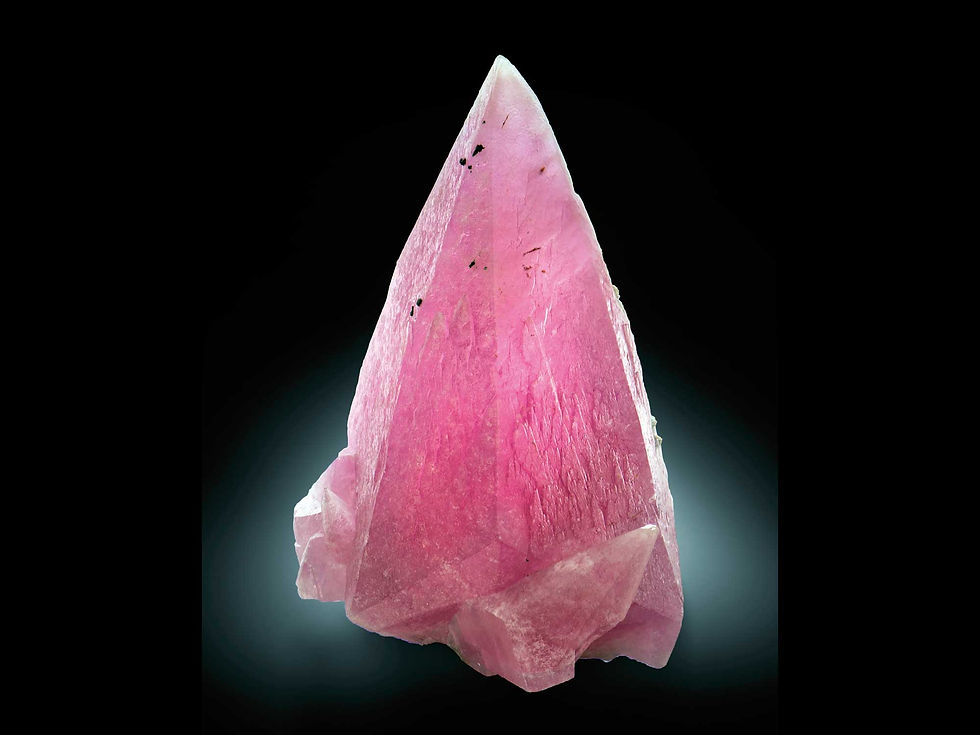
Neufund aus der Mashamba-West Mine, Revier Kolwezi, Kongo: Cobaltocalcit als enormes Skalenoeder, 7,8 cm hoch. Stufe von Christophe Gobin, Foto: Federico Picciani

Neufund aus der Mashamba-West Mine, Revier Kolwezi, Kongo: Kugeliger Malachit auf orangegelben Baryt-Tafeln, Breite 5,5 cm. Stufevon Christophe Gobin, Foto: Federico Picciani

Außergewöhnliche Neufunde aus der Kakanda Copper Mine, Kambove, Kongo: Kolwezit-Pseudomorphose nach Cuprit-Kristallen auf kobalthaltigem Dolomit. 19 cm breite Kabinettstufe. Stufe von Christophe Gobin/Dubai Gems, Foto: Federico Picciani
Neufund aus der Mashamba-West Mine, Revier Kolwezi, Kongo: Cobaltocalcit als enormes Skalenoeder, 7,8 cm hoch. Stufe von Christophe Gobin, Foto: Federico Picciani
1/4
As Christophe Gobin (Dubai Gems) informed us, some interesting new finds were made in the Republic of Congo (DRC) from March to September 2020.
The Kakanda Copper Mine in the Kambove district comprises several large open-pit copper mines. The deposit, located approximately 30 kilometers northwest of the town of Kambove, was discovered in 1910 and began producing copper ore in 1930 using a chambered mining method, initially from three shafts reaching depths of up to 350 meters at the edge of the open pits. The tubular ore body, composed of covellite, chalcocite, and chalcopyrite within dolomitic host rock, is approximately 800 meters long, 300 meters wide, and 30 meters thick. In the northern part of the ore body, entire "caves" containing stalactite malachite were encountered near the surface. Starting in 2013, the operator, Boss Mining SPRL, commissioned new processing plants to optimize the extraction of primary copper/cobalt ores. Boss Mining is a subsidiary of Eurasian Natural Resources (ENRC), an internationally operating Kazakh mining company headquartered in Nur-Sultan and London.
Currently, only the Kakanda South Pit, approximately 1.5 km long and 700 m wide, is in operation. This open-pit mine recently yielded excellent geodes, roughly the size of a decimeter, containing pinkish-red cobalt-bearing dolomite. This "cobalt dolomite" contains, in some areas, distorted cuprite cuboctahedra with edges up to 1 cm long, completely altered to dark olive-green kolwezite and sometimes bearing a light green malachite crust. Kolwezite is a rare copper/cobalt carbonate related to rosasite, known from only about a dozen locations worldwide. The type locality is the Musonoi Mine near Kolwezi, but Mashamba West (su) also yielded excellent material. In contrast, kolwezite was previously a rarity in the Kambove district, and the finds from the Kakanda mine can be considered a "premiere"—especially since the kolwezite here forms sharp-edged pseudomorphs after freely formed cuprite crystals! Approximately 150 km west of the Kambove district, in the Kolwezi district, lies the Mashamba West open-pit mine. Its 80 m thick and 25 m wide ore body contains almost 70% sulfide oxide ores, with an average of 3.8% Cu and 0.4% Co. It is 1250 m long and extends to a depth of 400 m. It was discovered in 1921; mining began in 1975. The Mashamba West open-pit mine has been operated since 2009 by Sicomines, a consortium controlled by China through the China Railway Group.
A mineralogical specialty of this quarry are typically reddish, often thin-tabular barite crystals, reaching up to 5 cm edge length and partially overgrown with globular-bottom malachite. Among the new finds are also large cobaltocalcite scalenohedra, which can reach more than 7 cm in height.
Stefan Weiß
bottom of page